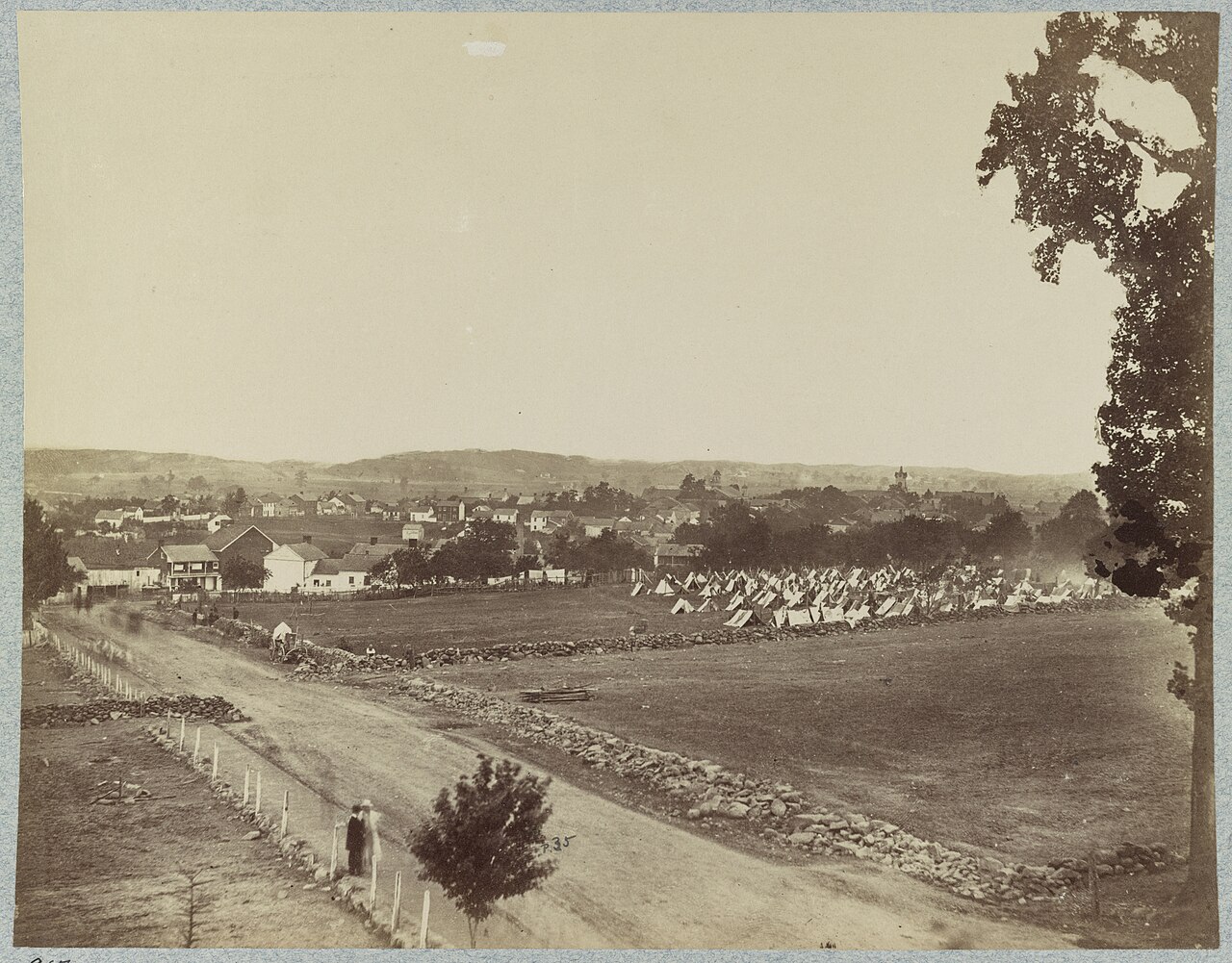
Source: Library of Congress, LCCN2014646001
Overview: Cemetery Hill sits at the southern edge of Gettysburg and served as the anchor of the Union defensive line from the close of the first day’s fighting through the end of the battle on July 3, 1863.
What Happened Here: When Union forces were driven back through Gettysburg on the afternoon of July 1, Cemetery Hill became the rallying point. Generals Winfield Scott Hancock and Oliver Otis Howard worked to organize retreating troops on the hill and establish a defensible position before Confederate forces could follow up their advantage. On the evening of July 2, Confederate infantry attacked the hill directly, briefly gaining a foothold near the base before being repulsed. The hill remained in Union hands for the duration of the battle.
Why It Matters: Holding Cemetery Hill on the evening of July 1 was one of the most consequential decisions of the battle. The high ground gave Union artillery commanding views over the town and the approaches from the north and west. It anchored the northern end of Cemetery Ridge and connected to Culp’s Hill on the right — forming the top of the Union fishhook line. If Confederate forces had taken the hill on July 1, the Union position for the following two days may not have been possible.
What Visitors Should Notice: The hill provides some of the broadest views on the battlefield, including sightlines back into Gettysburg and northward across the fields where Union troops retreated on July 1. The gatehouse of Evergreen Cemetery, which was present during the battle, still stands at the entrance. Artillery pieces remain positioned as they were during the battle. Monuments to multiple units are located on the hill. Confirm current access and conditions before visiting.
Visitor Note: Access, parking, trails, closures, and conditions can change. Confirm current visitor information before traveling.